|
THE SOUTH SHIELDS
PENDULUM EXPERIMENTS'
BY THE ASTRONOMER ROYAL
WE have already
briefly explained the arrangements made for this important series of
experiments with the pendulum, in the Harton Coal Pit, at South
Shields. At the request of several scientific gentlemen, the
Astronomer Royal, Professor Airy, gave an explanation of these
experiments to the members of the Mechanics' Institution and Working
Men's Institution of South Shields, on Tuesday week,' the 24th
ult. ; but it will be some time before the astronomical observations
obtained will have been sufficiently reduced to arrive at the
anticipated results.
The experiments at the colliery, which
extended over from three to four weeks, having been brought to a
close the instruments had been removed to the lecture-room, and were
placed on the opposite ends of the platform in exactly the same
relative positions as they had occupied at the pit-one set below,
and the other above ground. The apparatus consists of two
astronomical clocks with compensation pendulums, two invariable
pendulums (Kater's) suspended on strong tripod iron stands
immediately in front of the clock pendulums. An astronomical clock,
and an invariable pendulum were placed at each station with
barometer and thermometer attached which were regularly observed, so
that the necessary corrections might be made far atmospheric
resistance, variations of temperature, &c. There was also at each
station a galvanic signal-needle and these were connected by means
of insulated wires, placing the observers in electric communication.
The upper and lower stations at Harton Pit were exactly in a
vertical line, and distant nearly a quarter of a mile, and at each
station the instruments were carefully enclosed to prevent the
vibrations of the pendulums being affected by currents of air.
James Mather Esq., occupied the chair at the meeting at Shields and,
with a few well-timed observations, introduced' the
distinguished lecturer. The Astronomer Royal commenced by observing
that the present lecture was due to the people of South Shields and
the county of Durham generally, in return for the very kind
assistance which he had received. He also acknowledged his'
obligation to the Durham Observatory. Mr. Airy next proceeded to
state that his grand object was to arrive at the weight of our
globe-the earth-it being necessary to know this before we can
proceed to determine the weight or mass of' the sun, moon and
planets, which is of the utmost importance to practical astronomy.
The size and figure of the earth being now pretty accurately known,
it only remains to determine its mean density, i.e., the average
weight of say a cable foot, and the total weight of the globe is
easily calculated. The Astronomer Royal then proceeded to detail the
experiments. Harton Pit is 1260 feet deep; its mode of ascent and'
descent is by "cage and tub;" which Is made in either way, with the
smoothness of a railway carriage, in less than two minutes. The
extensive nature of this pit may be judged of by the amount of
passages which it contains in its workings, in connection with its
other shaft, St. Hilda. They are upwards of 100 miles; and there are'
underground passages more than two & half miles in a direct line. A
model Zenith-Sector was explained in connection with the late Dr.
Maskelyne's experiments and observations at the' mountain
Schehallien, in Scotland, in 1774. Professor Airy next detailed the
various experiments with the Torsion Balance by Cavendish, Retch,
and the late Francis Baily.
The results of the above experiments
show the mean density of the earth to be five to six times the
weight of water.' This was the state of the inquiry in 1826,
when Professor Airy and Dr. Whewell saw hat the problem might be
solved in' an entirely different manner. A little reflection Is
sufficient to show that, if the mean density of the earth be from
five to six times that of water, as indicated by previous
experiments, the interior of the earth must be considerably heavier
than its super stratum, which, so far as we have been able to
penetrate, we know to be little less than one-half that weight. Now
the question arose, how was this to he determined ? How were we to
ascertain whether the centre of the globe was a mass of matter,
probably as dense as gold or platinum? Messrs. Airy and Whewell
directly saw that if this was the case it would be most easily
settled by observing the number of vibrations made by a pendulum
swung at the surface' of the earth and at the bottom of the
deepest mine. The number of vibrations of the pendulum is a correct
measure of the power of gravitation; and, as we penetrate the
comparatively light super-strata or crust of the globe, and
approach the much denser and heavier mass forming the interior, the
attraction of gravitation will be considerably increased, and the
effect will be to accelerate the vibration of the pendulum, i e. to
make it go quicker. This principle forms the basis of the
Harton Pit experiments. Mr. Airy here enumerated the many
difficulties to be encountered, and the many precautions to be
used in the prosecution to such delicate inquiries. He then
proceeded to state that he and Dr. Whewell attempted the experiment
at the Dolcoath mines in Cornwall in the year 1828, but were
completely defeated. One principal difficulty was the comparison of
the clocks at the top and bottom in the mine, which at that
time could only be managed by conveying a chronometer, in the most
inconvenient manner, down a series of ladders altogether different
from being lowered direct to the bottom in the cage at Harton
Colliery, in spite of this difficulty they persevered until from
some serious accident, the mine was inundated with water, an they
were "drowned out" Mr. Airy here remarked that as it was necessary
in these cases to combine philosophy with pertinacity he had
lately resolved to renew the attempt, but with the new element
before mentioned-viz., the Electric Signal. This enabled the
two observers to know the exact instant at which the clock time was
to be noted at both stations, which was done every four hours,
night and day for four or five days, when the invariable pendulums
were changed-the pendulum which had been swinging at the upper
Station was take down the pit and hung up in front of the clock at
the lower station, and that which had been down the previous five
days was brought to the station at the surface, and a new series of
observations commenced : in this way any difference in the lengths
of the pendulums was got rid of: Mr. Airy thought that, with
care, the final error of the pendulum would not exceed one-tenth of
a second per day.' The necessary elements or data, for the
calculation of the mean density of the earth by this method,
are-first, the difference in the number of the vibrations at the top
and bottom of the mine; and, secondly, the thickness and mean
density, or specific gravity, of the outer shell of the globe
which could be pretty easily arrived at. The Astronomer Royal
demonstrated by the assistance of a diagram, the effect which the
outer crust would ; produce on the lower pendulum, which,
fortunately, maybe said to be none at all. Professor Airy, in
conclusion stated that, before he could say whether the results
would show any difference at all, many long calculations and
deductions would require to be made. The figures recorded "
looked well," and reflected the highest credit on his six
assistants, who were the most careful observers he could desire. Mr.
Ingham, M.P., in moving a vote of thanks to the Astronomer Royal,
thanked him for having, at his request issued a ticket to each of
the members of the South Shields Mechanics' Institution.
To this report of
the lecture, abridged from the Newcastle Chronicle, we add a few
details. The position of the two pendulum rooms, was one at the top
of the pit, the other at the bottom, within 100 yards of it, exactly
vertical. The instruments in the upper and lover rooms were
facsimiles of each other; and at certain intervals, to correct any
irregularity, those at the top were placed below, and those below,
above, changing places. The upper and lower astronomical clock,
exactly regulated to each other, had each on the balls of their
pendulums an Illuminated disk, about the size of a crown-piece.
Exactly in front, and within a few inches, hung a free (Kater's)
pendulum, suspended on very hard steel, shaped to an obtuse angle,
moving on an agate plane. The number of vibrations of the clocks
within any given time, are of course registered by the clocks
themselves. The number of the vibrations of the free pendulums,
produced exclusively by gravitation, were ascertained exactly by
their proportionate number to those of the clocks. At intervals each
free pendulum, which moves more quickly than the clock pendulum,
passes and re-passes in front of the latter, exposing, first on the
right and then on the left, the illuminated disk on the clock
pendulum. When a certain series has been gone through, the
illuminated disk is covered for a second or two by the free pendulum
in front; and this ; obscuration or coincidence, marks exactly the
proportionate number of vibrations due to each. The exact time is
then noted, the temperature, the barometric pressure, the relative
time of the clocks above and below, by the galvanic signal needle;
and then the observation is complete, both in the mine and at the
surface.
This coincidence requires so exact an observation, and
from a direct line in front, that a small telescope is fixed in the
most precise manner within a few feet, to make the observations in
which so much precision and care were used that the tenth of a
second was frequently noted, which develops in the calculations in
some instances nearly the four hundredth part of that brief period
of time.
To ascertain the weight of the earth's crust will be
more open to error. It requires that every description of stratum,
lying between the upper and lower pendulum for these 7260 feet
should have its weight exactly found, as well as its thickness
measured. In some places, near the surface, there are clay and earth
; in others, as you descend, sandstone, limestone, shale, and then
seams of coal ; some of the strata are saturated with water, others
quite dry. All these varieties of deposits, in their respective
conditions, must be distinctly examined and weighed. Difficult, as
it may appear, all this may be done; and the genius that has
hitherto arranged and developed this important experiment will
doubtless find means to complete the operation.
Mr. Dunkin, of
the Royal Observatory, Greenwich, conducted the experiments in
Professor Airy's absence, assisted by Mr. Ellis, of the same
Observatory; Mr. Pagson, of the Radcliffe Observatory, Oxford; Mr.
Rumkin, of the Durham Observatory; Mr. Creswick, of the Cambridge
Observatory; and Mr. Simmonds, of the Red-hill Observatory, Surrey.
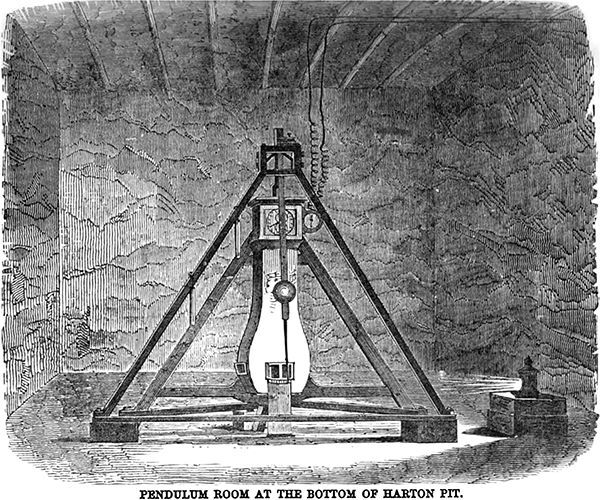
The accompanying Illustrations show a view of Harton Pit, which is
merely interesting as being the scene of the observations. The lower
Engraving shows Professor Airy's apparatus in situ in the room built
for its reception at the bottom of the pit shaft 1260 feet below the
surface. The lantern placed on the block is for the purpose of
illuminating the pendulum disk, there being a glazed aperture in the
side of side of the clock to' admit the light. The spiral wires
are the telegraphic conductors, which were carried up to the ceiling
through the wall, and so up the shaft to the upper station. The
instruments suspended from the iron support on the left, are two
thermometers. No figures are introduced, inasmuch, as during the
observations, no one was admitted into the room; the observer being
seated in a separate apartment, and making his observations by means
of a telescope through an aperture in the wall. Professor Airy has
kindly agreed to forward his lecture, explanatory of the noble
subject, written in extense to South Shields for publication.
|